
The Student Debt Trap:
Why It’s Time for a Halal Alternative to Financing Higher Education…
FEBRUARY 5, 2026

In the modern West, higher education increasingly forces Muslim families into an impossible choice between success and spiritual obedience
The Student Debt Crisis Facing Muslim Families in the West
Every Muslim parent knows the feeling. You look at your child—sleeping peacefully, full of innocence and potential—and you dream of their future. You imagine them as a doctor saving lives, an engineer building bridges, or a scholar defending the truth. You pray for their success in this life and the next.
But in the modern West, this dream is on a collision course with a nightmare.
As that child grows, the path to their success becomes paved with a specific type of ruin: interest-based debt. Tuition fees have skyrocketed, turning what was once a communal obligation into a premium luxury product. The university system, once a sanctuary for the mind, has become a marketplace where our children are not treated as learners, but as customers. Or worse, as securitized assets for lenders.
For the Muslim family, this is not just a financial headache; it is a spiritual crisis. We are caught in a devastating paradox: we are commanded by our faith to seek knowledge (ILM), yet the primary vehicle to access that knowledge in the West requires us to engage in Riba (usury)—a sin so grave the Qur’an equates it to waging war against God.
We cannot continue to sleepwalk into this trap. It is time to stop viewing student debt as an “unavoidable reality” and start treating it as a community emergency that demands a Halal solution.
Student debt quietly mortgages our children’s futures, draining barakah, delaying marriage, and replacing spiritual peace with lifelong anxiety
The High Cost of “Free” Money
The normalization of student debt is one of the most successful psychological tricks of the modern age. Banks and government lenders have convinced an entire generation that signing away their financial freedom at 18 is a “rite of passage.”
But let us look at this through the lens of Islamic logic. Islam prohibits Riba not to make life difficult, but to protect human dignity. Interest is the extraction of wealth without work; it is the commodification of time itself. When a student takes a loan, they are selling their future labor for a price they cannot control.
The emotional and social toll of this transaction is devastating. We see young Muslim men and women, brilliant and capable, paralyzed by the psychological weight of their balance sheets.
- The Death of Barakah (Blessing): How can a career started with Haram financing bring true peace? We see graduates earning high salaries but feeling like their money “disappears”—devoid of blessing, consumed by repayments.
- The Delay of Nikah (Marriage): This is a quiet tragedy in our community. Young men delay marriage for a decade because they feel they “cannot afford a family” while carrying negative net worth. The debt trap is directly contributing to a crisis of chastity and family formation.
- The Erosion of Sakinah (Tranquility): Debt creates anxiety. It forces our youth to choose careers based on salary alone, abandoning non-profits, community work, or scholarship because “those jobs won’t pay the loan.”
We are effectively placing a mortgage on our children’s souls before they even earn their first paycheck.
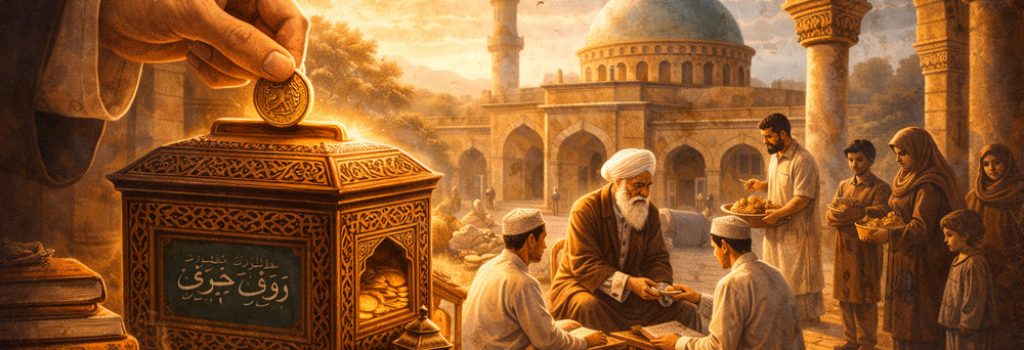
The solution is not kinder banks, but reviving forgotten Islamic systems of collective responsibility, patience, endowment, and long-term community planning for debt-free education worldwide today
Reviving the Waqf: A Halal Path to Debt-Free Education
The solution does not lie in asking non-Muslim banks to be nicer. The solution lies in looking in the mirror.
We have forgotten who we are. Historically, the Islamic civilization was the pioneer of the Endowment (Waqf). For over a thousand years, education in the Muslim world was free. It was not funded by the state or by loans, but by the community.
Great women like Fatima al-Fihri did not build the world’s first university (Al-Qarawiyyin) by charging tuition. She built it by endowing her wealth for the sake of Allah. The logic was simple: Education is a collective responsibility. The rich sustained the students so the students could sustain the future.
Somewhere along the way, we adopted a hyper-individualistic mindset: “My child, my problem.” We need to destroy this thinking. The Prophet (peace be upon him) described the Ummah as one body—if one part aches, the whole body suffers. Today, our students are aching. We must revive the Waqf mentality, updated for the 21st century.
Solution 1: The Micro-Strategy (The “£1 a Week” Model)
The journey to financial freedom begins with Niyyah (intention) and discipline. We need to normalize the “Education Fund” not as a financial product, but as a spiritual duty for every parent.
In Islam, the most beloved deeds to Allah are those that are consistent, even if they are small. This is the logic of the “Micro-Strategy.” Imagine if, the day a child is born, the family opens a Sharia-compliant investment account. The parents, grandparents, and uncles commit to a tiny sum—£1 or $5 a day.
- The Spiritual Dimension: This small sacrifice is a form of Tawakkul (trust in God) tied to action (Al-Akhdh bil-Asbab). It is a daily promise that “I will prepare a Halal path for my child.”
- The Power of Time: Compounding returns are a mathematical reality. Over 18 years, that small daily sacrifice grows into a fortress.
- The Outcome: When the child turns 18, the fund unlocks. The capital is not a handout; it is a shield. It protects them from the desperation that leads to Riba.
This changes the narrative from fear (“How will we pay?”) to preparation (“We have been building this for you”).
Solution 2: The Macro-Strategy (The “Yusuf Bond”)
However, individual discipline is not enough for the poor or those who started late. We need a systemic solution. We need “Patient Capital.”
We can derive a powerful economic framework from Surah Yusuf. When Prophet Yusuf (AS) interpreted the King’s dream, he introduced a concept of cyclical resource management. You save during the seven years of abundance to survive the seven years of drought. This is Tadbir—divine planning.
We can apply this to a community-wide 21-Year Education Bond:
Phase 1: Accumulation (Years 0–7)
The community pools its capital. We invest not in stock market gambling, but in the real economy—trade, property, logistics.
- The Logic: No withdrawals. Just as Yusuf (AS) stored the grain in its ear to preserve it, we keep the capital locked to build resilience. We are planting the seeds.
Phase 2: Stabilization (Years 7–14)
The investments begin to bear fruit. But instead of consuming the harvest, we reinvest the majority.
- The Logic: We take only a small profit. The goal is not greedy extraction, but strengthening the foundation for the next generation.
Phase 3: Distribution (Years 14–21)
This is the period of “feeding.” The students—our children—now need the funds.
- The Logic: Investors agree to take zero profits during this phase. The growth achieved over the previous 14 years is used to pay tuition fees. It is a transition from Investment to Sadaqah (charity) and support.
Phase 4: Liquidation (Year 21)
The cycle ends. Investors receive their principal back. They have not lost money, but they have gained something far more valuable: the pleasure of Allah and a generation of debt-free graduates.

Talha Ahmad Azami
ROTA Technologies
Founder